Recent Posts

Pages: 1 2 3 [4] 5 6 ... 10
31


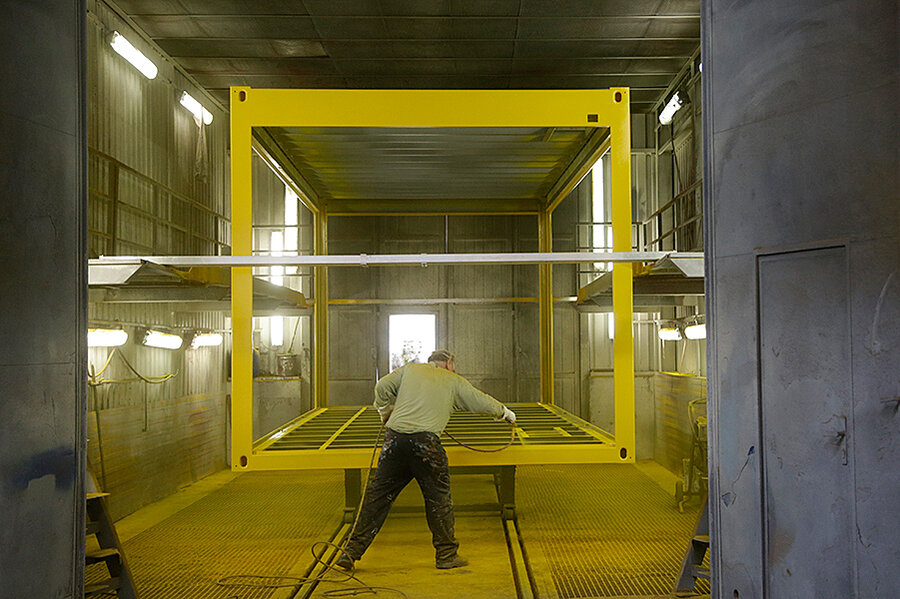
      A worker paints a frame for a modular container at a plant in the village of Supikovice, Czech Republic, Tuesday. The company which belongs to the modular division of the Paris-based Touax Group has been recently benefiting from orders from Germany that uses these modular like buildings to house thousands of migrants. Petr David Josek/AP
32


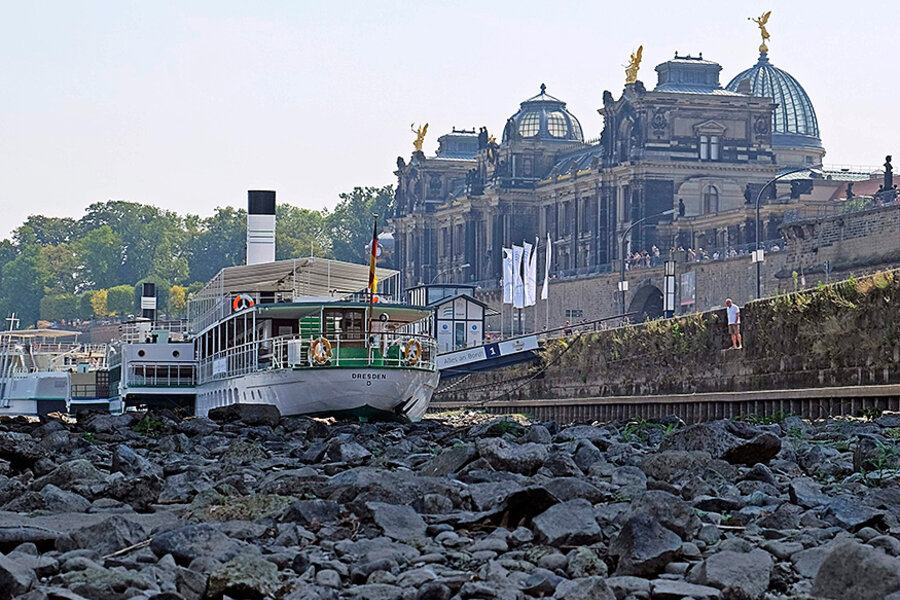
          Ships are moored near the Old Town as the water level of Elbe river drops due to hot temperatures in Dresden, Germany, Tuesday. Matthias Rietschel/Reuters
     
33


     Kashmiri villagers watch the funeral procession of a civilian, Bilal Ahmad Bhat, at Padgampora village south of Srinagar, India, Wednesday. Bhat was killed on Tuesday after Indian security forces allegedly opened fire on protesters who were protesting against the killings of two suspected militants in an encounter with Indian security forces, local media reported. Danish Ismail/Reuters
34
All Items Gold Related / All Hail Our Banking Overlords!
« Last post by Golden Oxen on July 23, 2015, 08:33:46 am »

          All Hail Our Banking Overlords!


You really have to be paying attention to see what’s truly going on these days. The keepers of the system, that is the banking elites, now openly control everything -- though you'd never know that by listening to the media.

Consider this:

    Eurozone backs €7bn bridging loan

    Jul 16, 2105

    Eurozone ministers have agreed to give Greece a €7bn (£5bn) bridging loan from an EU-wide fund to keep its finances afloat until a bailout is approved.

    The loan is expected to be confirmed on Friday by all EU member states.

    In another development, the European Central Bank (ECB) agreed to increase emergency funding to Greece for the first time since it was frozen in June.

    The decisions were made after Greek MPs passed tough reforms as part of a eurozone bailout deal.

How generous of the finance ministers of all those EU member states to agree to a “bridge loan” that will help Greece "keep its finances afloat". This should provide the people of Greece with a bit of breathing room, right? Maybe access to their bank accounts (finally!), perhaps?

No, not at all. Here’s what the entirety of the “”loan”” will go towards instead:

    The bridging loan means Greece will be able to repay debts to the ECB and IMF on Monday.

Ummmm…that “money” will not ever go anywhere near Greece.

This is all merely electronic window-dressing for entirely esoteric bookkeeping purposes. Servers will blink at one location in Europe as digital 1s and 0s are transmitted to another. The electronic balances at the ECB and the IMF will change, but not much else.

The people of Greece will see none of it. Nor will they see their bank accounts unfrozen.

This act of banker "largess" is, of course, of, by, and entirely for the bankers. It has nothing to do with Greece or its people, about whom the banker class cannot care less.   

But, they hide this disdain under and increasingly thin and condescending veneer of graciousness. Take, for example, the recently-announced 'generosity' of the powers that be -- that is, the banking powers that be -- which will permit the long suffering depositors to…*cough*…deposit more money into the banks:

    Greece: Banks Can Reopen ... for Deposits  :D :D

    Jul 17, 2015

    Greek banks will reopen Monday after a three-week closure, the country's deputy finance minister says, though withdrawal restrictions will stay in place. Bank customers "can deposit cash, they can transfer money from one account to the other," but they can't withdraw money except at ATMs, the official says, and a withdrawal limit of 60 euros ($67) a day will stay in place, he said, though Greek authorities are working on a plan to allow people to roll over access to their funds so that if they don't make it to a bank machine one day, they can take out 120 euros the next day.

    Yeah, depositing more money into the Greek banking system is exactly what all 12 remaining Greek idiots are clamoring to do...everybody else just wants their money back, thank-you-very-much.

Obviously, the only rational response of anybody in Europe watching this charade of theft continue would be to sell gold, right? (which has happened vigorously ever since the Greek crisis began) Because, you know, nothing says “confidence” quite like selling your gold so you can then park that money in a bank that may not let you withdraw it again.

Of course, we here at Peak Prosperity hold to the view that everything, and we mean everything, in our ””markets”” is stage-managed. And that especially includes gold. The central banks are demanding and commanding complete fealty to their story line, no exceptions tolerated.  We are at that all-or-nothing moment in history when everything either works out perfectly or it all falls apart.

Savers have to be punished so debtors can be saved.

Why? Because if debtors are rescued, that makes it possible for more debts to be issued in the future..

And why is that important? Because the banking system needs ever more loans in order to survive.

Why do we slavishly feed a banking system that is rapacious, insatiable and always threatening calamity whenever it doesn’t get exactly everything it wants, when it wants it? That is a question nobody in power is willing to address.

Why not? Because there's no good reason to do it -- unless you're a bank, or one of the many proxy agents (like politicians) receiving kick-backs from the banks.

We have a banking system that feeds on the blood, sweat and tears of the public. But the public's collective output is no longer ‘enough’ to subsidize everything that central planners have promised. So with a stagnating/shrinking pie – surprise! – the group that writes the rules, the banks, has decided that they should be the ones to get as much of it as possible.

Naturally, this will not work for very long.  History is replete with examples why it can’t.  Just consider the root meaning of “bankrupt” which has an interesting history:

    The word actually comes from Italian banca rotta, a broken bench (not a rotten one, as the false friend of Italian rotta might suggest — it’s from Latin rumpere, to break). The bench was a literal one, however: it was the usual Italian word for a money dealer’s table.  In his dictionary, the great Dr Johnson retold the legend that when an Italian money trader became insolvent, his table was broken.

    (Source)

To “break the banker’s table” means to smash the money lender’s physical place of business after they have taken or lost all of your wealth.  It’s speaks of an act of anger by the betrayed. And that’s where the banking system finds itself again and again over time, for the exact same reasons all through history -- today being no different in anything but scale and complexity.
Conclusion

You have to read past the headlines today because they quite often say exactly the opposite of what’s actually happening.  Like today’s description spinning GE’s 2Q, $1.38 billion earnings loss as a 5% rise in profits.

The bankers and financiers are badly overplaying their hands, again, and people are starting to catch on to the scam.

Real wealth is tangible things produced with tangible effort. Loans made out of thin-air 'money' require no effort and are entirely ephemeral.  But if those loans are used to acquire real ownership of real assets, then something has been exchanged for nothing and one party is getting screwed.

That’s what has just happened in Greece. And expect it to happen increasingly elsewhere, as Charles Hughes Smith and I recently discussed in this week's excellent Off The Cuff podcast.

If you had asked me ten years ago if there was any chance of Greece becoming a failed state within a decade, I would have said ‘No, no chance.’  But here we are. In ten years, I suspect, we’ll be marveling over all the other failed states as the rot proceeds from the outside in. Again, Charles does a wonderful job articulating why in his recent report More Sovereign Defaults Are Coming.

There’s simply too much debt and too little cheap oil for there to be any other trajectory to this story. Boneheadedly, our leadership is so out-of-touch that their best response to this set of predicaments is to sacrifice the populace of an entire developed nation (for generations to come) just to keep the status quo stumbling along for a bit longer.

We need to all prepare for the inevitability that, as the rot proceeds, the people of Greece will not be the only casualties of the banks' attempts at self-preservation. They'll try to throw all of us under the bus before taking any losses themselves.
~ Chris Martenson
http://www.peakprosperity.com/blog/93588/all-hail-our-banking-overlords
35

Why I'm a Libertarian.  :'(


Jade Helm, Terrorist Attacks, Surveillance and Other Fairy Tales for a Gullible Nation


“Strange how paranoia can link up with reality now and then.”  – Philip K. Dick, A Scanner Darkly

Once upon a time, there was a nation of people who believed everything they were told by their government.

When terrorists attacked the country, and government officials claimed to have been caught by surprise, the people believed them. And when the government passed massive laws aimed at locking down the nation and opening the door to total government surveillance, the people believed it was done merely to keep them safe. The few who disagreed were labeled traitors.

When the government waged costly preemptive wars on foreign countries, insisting it was necessary to protect the nation, the citizens believed it. And when the government brought the weapons and tactics of war home to use against the populace, claiming it was just a way to recycle old equipment, the people believed that too. The few who disagreed were labeled unpatriotic.

When the government spied on its own citizens, claiming they were looking for terrorists hiding among them, the people believed it. And when the government began tracking the citizenry’s movements, monitoring their spending, snooping on their social media, and surveying their habits – supposedly in an effort to make their lives more efficient – the people believed that, too. The few who disagreed were labeled paranoid.

When the government let private companies take over the prison industry and agreed to keep the jails full, justifying it as a cost-saving measure, the people believed them. And when the government started arresting and jailing people for minor infractions, claiming the only way to keep communities safe was to be tough on crime, the people believed that, too. The few who disagreed were labeled soft on crime.

When the government hired crisis actors to take part in disaster drills, never alerting the public to which “disasters” were staged, the people genuinely believed they were under attack. And when the government insisted it needed greater powers to prevent such attacks from happening again, the people believed that, too. The few who disagreed were told to shut up or leave the country.

Finally, the government started carrying out covert military drills around the country, insisting they were necessary to train the troops for foreign combat, and most of the people believed them. The few who disagreed, warning that perhaps all was not what it seemed, were dismissed as conspiracy theorists and quacks.

By the time the government locked down the nation, using local police and the military to impose martial law, there was no one left in doubt of the government’s true motives – total control and domination – but there was also no one left to fight back.

Now, every fable has a moral, and the moral of this story is to beware of anyone who urges you to ignore your better instincts and trust the government.

In other words, if it looks like trouble and it smells like trouble, you can bet there’s trouble afoot.

For instance, while there is certainly no shortage of foul-smelling government activities taking place right now, the one giving off the greatest stench is Jade Helm 15. This covert, multi-agency, multi-state, eight-week military training exercise is set to take place from July 15 through Sept. 15 in states across the American Southwest.

According to official government sources, “Jade Helm: Mastering the Human Domain” is a planned military exercise that will test and practice unconventional warfare including, but not limited to, guerrilla warfare, subversion, sabotage, intelligence activities and unconventional assisted recovery. The training exercise will take place in seven different southwestern states: California, New Mexico, Colorado, Arizona, Texas, Utah and Nevada.

U.S. Army Special Operations Command will primarily lead this interagency training program but the Navy Seals, Air Force Special Operations, Marine Special Operations Command, Marine Expeditionary Units, 82nd Airborne Division and other interagency partners will also be involved. Approximately 1,200 troops are expected to participate in these exercises.

The training is known as Realistic Military Training because it will be conducted outside of federal property. The exercises are going to be carried out on both public and private land, with the military reportedly asking permission of local authorities and landowners prior to land usage. The military map listing the locations that will host the exercise shows Texas, Utah and the southern part of California as “hostile territory.” According to U.S. officials, these three areas are marked as hostile to simulate environments where American troops are viewed as the enemy. The other areas on the map are marked as permissive, uncertain (leaning friendly), or uncertain (leaning hostile).

Military officials claim that the southwestern states were chosen because this exercise requires large areas of undeveloped land as well as access to towns and population hubs. These states purportedly also provide a climate and terrain that is similar to that of potential areas of combat for the United States, particularly Iraq, Iran and Syria.

Now, the mainstream media has happily regurgitated the government’s official explanation about Jade Helm. However, there is a growing concern among those who are not overly worried about being labeled conspiratorialists or paranoid that the government is using Jade Helm as a cover to institute martial law, bring about total population control, or carry out greater surveillance on the citizenry.

In the first camp are those who fear that Jade Helm will usher in martial law. These individuals believe that by designating the two traditionally conservative and Republican-dominated states, Utah and Texas, as hostile territory, while more Democratic states like Colorado and California are marked as friendly, the military plans to infiltrate the states with large numbers of gun owners and attempt to disarm them.

Adding fuel to the fire is the mysterious and sudden temporary closures of five Walmart stores in Texas, California, Oklahoma and Florida, two of which are located near Jade Helm training sites. Those in this camp contend that the military is planning to use the Walmart stores as processing facilities for Americans once martial law is enacted.

Pointing to the mission’s official title, “Jade Helm: Mastering the Human Domain,” there is a second camp that fears that the military exercises are merely a means to an end – namely total population control – by allowing the military to discern between friendly civilians and hostiles. This concern is reinforced by military documents stating that a major portion of Jade Helm training will be about blending in with civilians, understanding how to work with civilians, using these civilians to find enemy combatants and then neutralizing the target.

In this way, the United States military is effectively using psychological warfare to learn how people function and how to control them.

As a study written by military personnel states, mastering the human domain, also known as identity processes, means “use of enhanced capabilities to identify and classify the human domain; to determine whether they are adversarial, friendly, neutral, or unknown.” The study later states that identity processes can be used to “manage local populations during major combat, stability, and humanitarian assistance and/or disaster relief operations.”

While the military has promised that the work they are doing is aimed for use overseas, we have seen first-hand how quickly the military’s weapons and tactics used overseas are brought home to be used against the populace. In fact, some of the nation’s evolutionary psychologists, demographers, sociologists, historians and anthropologists have been working with the Department of Defense’s Minerva Initiative to master the human domain. This security research includes “Understanding the Origin, Characteristics, and Implications of Mass Political Movements” at the University of Washington and “Who Does Not Become a Terrorist and Why?” at the Naval Academy Post Graduate School. Both studies focus on Americans and the different movements and patterns that the government can track to ensure “safety and security.”

The Department of Homeland Security (DHS) is also working to infiltrate churches across the country to establish a Christian Emergency Network, carry out emergency training exercises to prevent and prepare for disasters (active shooter drills and natural disaster preparedness), and foster two-way information sharing, while at the same time instituting a media blackout of their activities. As the DHS continues to establish itself within churches, a growing number of churches are adopting facial recognition systems to survey their congregations, identify and track who attends their events, and target individuals for financial contributions or further monitoring. As the partnership between churches and the DHS grows, their facial recognition databases may be shared with the federal government, if that is not already happening.

Finally, there is the third camp, which fears that Jade Helm is merely the first of many exercises to be incorporated into regular American life so that the government can watch, study and better understand how to control the masses. Certainly, psychological control techniques could be used in the future to halt protests and ensure that the nation runs “smoothly.”

It remains to be seen whether Jade Helm 15 proves to be a thinly veiled military plot to take over the country (one lifted straight out of director John Frankenheimer’s 1964 political thriller "Seven Days in May"), turn the population into automatons and psychological experiments, or is merely a “routine” exercise for troops, albeit a blatantly intimidating flexing of the military’s muscles.

However, as I point out in my book Battlefield America: The War on the American People, the problem arises when you add Jade Helm to the list of other troubling developments that have taken place over the past 30 years or more: the expansion of the military-industrial complex and its influence in Washington DC, the rampant surveillance, the corporate-funded elections and revolving door between lobbyists and elected officials, the militarized police, the loss of our freedoms, the injustice of the courts, the privatized prisons, the school lockdowns, the roadside strip searches, the military drills on domestic soil, the fusion centers and the simultaneous fusing of every branch of law enforcement (federal, state and local), the stockpiling of ammunition by various government agencies, the active shooter drills that are indistinguishable from actual crises, the economy flirting with near collapse, the growing social unrest, the socio-psychological experiments being carried out by government agencies, etc.

Suddenly, the overall picture seems that much more sinister. Clearly, there’s a larger agenda at work here, and it’s one the American people had better clue into before it’s too late to do anything about it.

Call me paranoid, but I think we’d better take James Madison’s advice and “take alarm at the first experiment on our liberties.”

This article contributed courtesy of John Whitehead and The Rutherford Institute.

http://www.thedailybell.com/editorials/36399/John-Whitehead-Jade-Helm-Terrorist-Attacks-Surveillance-and-Other-Fairy-Tales-for-a-Gullible-Nation/
36
Art / Re: Favorite Art Works of Members - ICARUS
« Last post by Golden Oxen on June 03, 2015, 12:09:38 am »

 
                                                        Icarus . Son of Daedalus who dared to fly too near the sun on wings of feathers and wax. Daedalus had been imprisoned by King Minos of Crete within the walls of his own invention, the Labyrinth. But the great craftsman's genius would not suffer captivity. He made two pairs of wings by adhering feathers to a wooden frame with wax. Giving one pair to his son, he cautioned him that flying too near the sun would cause the wax to melt. But Icarus became ecstatic with the ability to fly and forgot his father's warning. The feathers came loose and Icarus plunged to his death in the sea.


The Fall of Icarus
Peter Paul Rubens - 1636


The Fall of Icarus
Laurent de La Hyre - Date unknown


Lament for Icarus
Herbert James Draper - 1898


Study for Daedalus Attaching Icarus' Wings
Joseph Marie Vien - circa 1754


Daedalus Attaching Icarus' Wings
Joseph Marie Vien - circa 1754


Henri Matisse: The Fall of Icarus (1947)


Icarus (Henri Matisse,1947)


Landscape with the Fall of Icarus


William Carlos Williams, 1883 - 1963


According to Brueghel
when Icarus fell
it was spring

a farmer was ploughing
his field
the whole pageantry

of the year was
awake tingling
near

the edge of the sea
concerned
with itself

sweating in the sun
that melted
the wings’ wax

unsignificantly
off the coast
there was

a splash quite unnoticed
this was
Icarus drowning


37
MUST READ ARTICLE MEMBERS.  Professor Fekete is predicting a return to gold and soon!

  The Spontaneous Remonitization of Gold and the Revival of the Moribund World Trade


New Austrian School of Economics and the Lips Institute

Summary

In the words of the Old Testament “the use of false weights and measures is the greatest abomination in the eyes of the Lord”. The Great Coin Melt of 1933 by Franklin D. Roosevelt certainly answers the description “greatest abomination”. He confiscated the gold coins of the American people; he melted them down and wrote up the value of the proceeds. He pretended to have compensated people for their stolen gold by giving them Federal Reserve notes in exchange. These notes have, in hardly more than a generation, lost 90 percent of their purchasing power.  full article...

   http://www.drschoon.com/articles%5CAEFSpontaneousRemonetizationOfGold.pdf
38
Gold Research / A Portrait of the Classical Gold Standard
« Last post by Golden Oxen on May 12, 2015, 07:43:03 am »
"The world that disappeared in 1914 appeared, in retrospect, something like our picture of Paradise," wrote the economist Cecil Hirsch in his June 1934 review of R.W. Hawtrey’s classic, The Art of Central Banking (1933). Hirsch bemoaned the loss of the far-sighted restraint that had once prevailed among the "bankers' banks" of the West, concluding that modern times "had failed to attain the standard of wisdom and foresight that prevailed in the 19th century."

That wisdom and foresight was once upon a time institutionalized throughout an international monetary culture — gold-based, wary of credit, and contemptuous of debt, public or private. This world included central banks including the Bank of England, the Bank of France, the Swiss National Bank, the early Federal Reserve, the Imperial Bank of Austria-Hungary, and the German Reichsbank. But the entrenched hard-money ideology of the time restrained all of them. The Bank of Russia, for example, which once required 50 percent to 100 percent gold backing of all notes issued, possessed the second largest gold reserves on the planet at the turn of the twentieth century.

"The countries that were tied together in the gold standard system represented to a not inconsiderable degree a community of interest in and responsibility for the maintenance of economic and financial stability throughout the world," recounted Aldoph C. Miller, member of the Federal Reserve Board from 1914 to 1936, in The Proceedings of the Academy of Political Science, in May 1936. "The gold standard was the one outstanding symbol of unity and economic solidarity which the nineteenth century world had developed."

It was a time when "automatic market forces," as economists of the day referred to them, prevailed over monetary management. Redeemability of money in (fine) gold ensured, within limits, stability in foreign exchange rates. Credit was extended only as far as reserve ratios would allow, and central banks were required to keep fixed reserves of gold against notes-in-circulation and against demand deposits.

When Markets Dominated Monetary "Policy"

Gold flows regulated international price relationships through markets, which adjusted themselves accordingly: prices rose when there was an influx of gold — for example, when one country received a debt payment from another country (always in gold), or during such times as the California or Australian gold rushes of the 1870s. These inflows meant credit expansion and a rise in prices. An outflow of gold meant credit was contracted and price deflation followed.

The efficiency of that standard was not impeded by the major central banks in such a way that "any disturbance of economic or financial character originating at any point in the world which might threaten the continued maintenance of economic equilibrium was quickly detected by foreign exchanges," Miller, the Federal Reserve board member, noted in his paper. "In this way, the gold standard system became in a very real sense a regime or rule of economic health, a method of catching economic disturbances in the bud."

The Bank of England, the grand master of them all, was the financial center of the universe, whose tight handle on its credit policies was so disciplined that the secured the top spot while not even holding the largest gold reserves. Consistent in its belief that protection of reserves was the chief, and only important, criterion of credit policy, England became the leading exporter of capital, the free market for gold, the international discount market, and international banker for the trade of other countries, as well as her own. The world was in this sense on the sterling standard.

The Bank of France, wisely admonished by its founder, Napoleon, to make sure France was always a creditor country, was so replete with reserves it made England a 500 million franc loan (in 1915 numbers) at the onset of the World War I. Switzerland, perhaps the last "19th-century-style" hold-out today with unlimited-liability private bankers and strict debt-ceiling legislation, also required high standards of its National Bank, founded in 1907. By the 1930s that country had higher banking reserves than the US; the Swiss franc was never explicitly devalued, unlike nearly every other Western nation’s currency, and the country’s domestic price level remained the most stable in the world.

For a time, the disciplined mindset of these banks found its way across the Atlantic, where the idea of a central bank had been long the subject of hot debate in the US. The economist H. Parker Willis, writing about the controversy in The Journal of the Proceedings of the Academy of Political Science, October 1913, admonished: "The Federal Reserve banks are to be 'bankers' banks,' and they are intended to do for the banker what he himself does for the public."

At first, the advice was heeded: in September 1916, almost two years after its founding on December 23,1913, the fledgling Fed worked out an amendment to its gold policy on the basis of a very conservative view of credit. This new policy sought to restrain "the undue and unnecessary expansion of credit," wrote Fed board member Miller, in an article for The American Economic Review, in June 1921.

The Bank of Russia, during the second half of the nineteenth century steered itself through the Crimean War, the Russo-Turkish War, the Russo-Japanese War, impending Balkan wars — not to mention all that was to follow — and managed to emerge with sound fiscal policies and massive gold reserves. According to The Economist of May 20, 1899, Russian holdings were 95 million pounds sterling of gold, while the Bank of France held 78 million sterling worth. (Austria-Hungary held 30 million sterling worth of gold and the Bank of England 30 million sterling worth of both gold and silver.) "Russia up to the very moment of rupture [with Japan, 1904–1905], was working imperturbably at the progressive consolidation of her finances," reported Karl Helfferich of the University of Berlin, at a meeting of The Royal Economic Society [UK] in December 1904. "Even in years of industrial crises and defective harvest, her foreign trade showed an excess of exports over imports more than sufficient to compensate payments sent abroad. And, as guarantee her monetary system she has succeeded in a amassing and maintaining a vast reserve of gold."

These banks, in turn, drew on the medieval/Renaissance and Baroque-era banking traditions of the Hanseatic League, the Bank of Venice, and Amsterdam banks. Payment-on-demand "in good and heavy gold" was like a blood-oath binding the banker-client relationship. The transfer of credit "did not arise from any such substitution of credit for money," noted Charles F. Dunbar, in The Quarterly Journal of Economics of April 1892, "but from the simple fact that the transfer in-bank saved the necessity of counting coin and manual delivery of every transaction."

Bankers were forbidden to deal in certain commodities, could not make loans or create credit for the purchase of such commodities, and forbade both foreigners and citizens from buying silver on credit unless the same amount in cash was in the bank. According to Dunbar, a Venetian law of 1403 on reserve requirements became the basis of US banking law on the deposits of public securities in the late 1800s.

After the fall of bi-metallism in the 1870s, gold continued to perform monetary functions among the main countries of the Western world (and the well-administered Bank of Japan). It was the only medium of exchange and the only currency with unrestricted legal tender. It became the vaunted "measure of value." Bank currency notes were simply used as auxiliary to gold and, in general, did not enjoy the privilege of legal tender.

The End of An Era

It was certainly not a flawless system, or without periodic crises. But central banks had to act in an exceptionally prudent manner given the all-over public distrust of paper money.

As economist Andrew Jay Frame of the University of Chicago, writing in The Journal of Political Economy, in January 1912, noted: "During panics in Britain in 1847 and 1866, when cash payments were suspended, the floodgates of cash were opened [by The Bank of England], the governor sent word to the street that solvent banks would be accommodated, and the panic was relieved." Frame then adds: "However, this extra cash and the increased loans that went with it were very quickly put to an end to avoid credit expansion."

The US was equally confident of its prudent attitude. Aldoph Miller, writing of Federal Reserve policy, remarked: "The three chief elements of the policy of a central bank or system of reserve holding institutions are best disclosed in connection with the attitude towards 1) gold 2) currency 3) credit." He noted proudly: "The federal reserve system has met [these] tests on the whole with remarkable success."

But after World War I, a different international landscape was left behind. England had been displaced as the center of international finance; the US and France emerged as the chief post-war creditor countries. The mechanism of the gold standard to which depreciated currencies could be related no longer existed. Only the US was left with a full gold standard. England and France had a gold bullion standard and other countries (Germany, primarily) had a gold-exchange standard.

A matrix of unbalanced trade relationships began to saturate the international economy. Then, with so many foreign countries attendant upon its speculative boom, the US manipulated its own domestic credit policies to ease credit and exchange-standard controls. This eventually culminated in an international financial crisis of 1931. Under Bretton Woods (1944), the gold standard was effectively abandoned: domestic convertibility was illegal and the role of gold was very constrained in favor of the dollar.

"It was, at least in theory, simple enough in the old days," wrote a wistful W. Randolph Burgess, head of the New York Federal Reserve, in 1938. "In the present strange new world, where the old gold portents have lost their former meaning, where is the radio beam which the central banker may follow? What is the equivalent of gold?"

The men of his era and of the late nineteenth century understood the meaning of such a question and, more importantly, why it is one that must be asked. But theirs was a different world, indeed — one without "QE," ZIRP," or "Unknown Knowns" as fiscal policy. And there were no helicopters, either.

https://mises.org/library/portrait-classical-gold-standard
39
                                    I'd Love To Change The World Lyrics

Everywhere is freaks and hairies
Dykes and fairies, tell me where is sanity
Tax the rich, feed the poor
Till there are no rich no more?

I'd love to change the world
But I don't know what to do
So I'll leave it up to you

Population keeps on breeding
Nation bleeding, still more feeding economy
Life is funny, skies are sunny
Bees make honey, who needs money, Monopoly

I'd love to change the world
But I don't know what to do
So I'll leave it up to you

World pollution, there's no solution
Institution, electrocution
Just black and white, rich or poor
Them and us, stop the war

I'd love to change the world
But I don't know what to do
So I'll leave it up to you


Songwriters: ALVIN LEE

                                           https://www.youtube.com/watch?t=141&v=sg6xaFZStEI


40
Thursday, April 23, 2015
The Rehypothecation of Gold, and Why It Matters

Claiming to own X quantity of gold is one thing, and reporting how many times the gold has been pledged as collateral is another.

When correspondent Scott A. Batten offered to write an explanation of the rehypothecation of gold and why it matters, I quickly accepted. Like many others, I have breezed over the word rehypothecation with the basic understanding that it means assets pledged by counterparties (such as the infamous copper stored in Chinese warehouses) are reused as collateral/repledged--in effect, the same assets are pledged as collateral multiple times.

But beyond this, I have not had a clear understanding of how the rehypothecation of gold reserves threatens the whole shaky edifice of Infinite Greed, oops, I mean neoliberal capital markets.

Here is Scott's commentary:

When introducing a new concept, it is best to start with the definition of the words to be used. In this case, the discussion of rehypothecation and how it places the world at risk with the fun and games played in the stock market.

Rehypothecation:

Rehypothecation occurs when your broker, to whom you have hypothecated -- or pledged -- securities as collateral for a margin loan, pledges those same securities to a bank or other lender to secure a loan to cover the firm's exposure to potential margin account losses.

When you open a margin account, you typically sign a general account agreement with your broker, in which you authorize your broker to rehypothecate.

Now, let’s put this into easy to understand language. Let’s say that you have ten dollars. You take it to the bank to let them “borrow” it, while paying you interest. What you have done, in reality, is given them your money to use as they see fit, while giving you a small percentage of the gains that they will earn. A bank would loan the money to a home buyer or perhaps a small business. At the very least, they can lend all the money in excess of their requirement to hold some cash as reserves--say 10% for ease of math.

They now have nine dollars to invest. Their last resort is to offer it to another bank for that bank to “hold”, because that bank doesn’t have enough money to meet its required reserves. Seems simple enough, right?

Welcome to the games bankers play to make money. Now that this simple format is in place, let’s move to where the serious dangers lie.

Precious Metals:

During World War II, many foreign countries feared that their gold reserves, which at the time backed their paper money, might be taken by an enemy and in 1939, the good old USA was a very neutral country, like Switzerland, only there was a much better deterrent than the Alps-- the Atlantic Ocean. So, many countries--England, France, and others--sent us their gold bars to be stored alongside ours in Fort Knox. Later, after the war was over, we convinced them that it was fine to leave it there and in fact, with the Cold War starting other countries joined in, including Germany.

Now, what good is a pile of gold sitting in a fort going to do? It costs a lot to protect it, and the US was paying a small sum in interest, while getting a smaller sum back in “protection fees”. So, the Federal Reserve had a wonderful idea, at least in their minds.

Since we have this gold, let’s issue paper on that gold as though it was ours, after all it is sitting in Fort Knox, and earn a bit of money on the side. So long as the Cold War lasted, the gold certainly wasn’t going anywhere. Here is where the trouble began. It was pretty small potatoes for a good while, until we went off the gold standard in 1971 during the Nixon Administration. What good is having a precious metal to back fiat currency, when a promise is just as good? Enter the danger zone.

Now, the gold in Fort Knox isn’t doing anything. So, what to do? Well, each bar of gold has a unique mark on it to say who owns it. The Cold War is still raging, so no one is going to ask for it back anytime soon. Let’s melt down some of that gold, just a small percentage of it, and sell it off as bullion. Gold is high and the foreign countries won’t ask for it all, so let’s skim a bit here and there. No one will know, and we can make money.

Then debts started to accrue, so they got brazen and started melting bars and reselling bars as their own gold, because they don’t want to use their own gold, when German gold is just the same, except for that little mark. Erase the mark and put your own on it and sell it as yours, using your gold as the “backer” in case Germany asks for some of it back.

Well, it wasn’t long until greed set in. Those gold bars that were sold to say, China or Japan, were resold to Austria or Iraq. Much like the bundling and reselling of home loans in the 1990’s, soon the German melted gold was in seven different countries with seven different marks, but no German mark upon them remained. This still wasn’t the breaking point though, after all there is still plenty of Gold in Fort Knox to cover what is owed to them.

I don’t know who’s idea it was, but it was a bad idea. They decided that they could sell paper promises of gold being held in the vaults. The last number I saw was 140%. Which means that if they have 100 pounds of gold, they can sell paper as though they have 140 pounds of gold. Now, they can also sell that gold outright as well. So, it's possible that they could sell 140 pounds of paper gold and sell a portion of the physical gold. too.

Confused yet? Here is where we stand today. No one knows how much gold is really in Fort Knox. We only know what they say is in Fort Knox. The same is likely true for the Federal Reserve and possibly the major banks; after all, if the Fed starts demanding to know what’s in those banks, they might have to show theirs too. So, let’s say that the economy starts to really go south around the world. As you know from the news, Germany asked to see their gold at Fort Knox and were denied, so they asked for their gold back. Smart move on Germany’s part in my mind. Answer from the Fed, we will get it to you sometime in the near future. This wasn’t challenged by Germany.

Why? Rehypothecation. Germany knows that they have been doing the same thing with gold that we have. It’s been sold to multiple people at the same time, under the theory that not everyone will want it at the same time, so we can just move it around as needed.

This game of musical golden chairs works fine, until the musical economy stops. When countries start to rack up debt and desire to sell their own gold to pay the bill, and they can’t get it, they get nervous. Now, if the economy is going south and the price of gold is heading up because of fear, those people holding paper gold in the form of futures or just deposit promises begin to sell off for profit or out of financial need. So long as it’s a trickle, no problem, but if it becomes a torrent....

Remember the 140% rule? Well, what if the Federal Reserve only kept 60% of the 100% that the paper gold was written on? Now there is an 80% shortage. Someone is about to have their musical golden chair pulled out from under them. They will get paid, BUT that payment will come as fiat currency. As the golden parachute deflates, how good is fiat currency? This is why there are so many on the fringe demanding to see the gold reserves and others are saying gold will hit $5,000 an ounce or higher. It is theoretically possible that for each gold promise, that it is backed by 1/5 or less of physical gold. No one knows, because no one can audit the physical gold.

China is getting ready to release their gold reserves. That is, they will do like the Fed and say how much they have. We cannot call them on their real reserves, because then they can do the same to us. Now, if all the gold is still in Fort Knox and the Federal Reserve, then the US can call for a real accounting and show ours as well.

However, if we don’t and China does, and calls for the US to do the same, then a lot of fear enters the market. There is a reason that people say "never own paper metals." This is that reason. You might get the value of that gold, but it will be in fiat currency and if things are crumbling then fiat promises become flat losses.

Thank you, Scott, for the explanation. It's a funny thing about financial games; whatever the Mainstream Financial Media mocks as conspiracy theories often later turn out to be accurate.

I do not claim any expertise in the gold/paper gold markets, but it's clear that claiming to own X quantity of gold is one thing, and reporting how many times the gold has been pledged as collateral is another. In a transparent financial system, the citizens of the U.S. would be invited to tour Fort Knox (in small, secure groups, of course) and count the nation's gold directly. What's the harm in showing off the gold to anyone willing to go through security?

Why keep the nation's gold reserves so mysteriously secret? What's the point in being so cagey about it? Maybe rehypothecation isn't the reason for the secrecy; then what is? Fear of precisely what? Isn't gold supposed to be a foolish relic? What's the danger in letting people look at the foolish relic and count the bars and note the serial numbers on the bars? What's the risk in that?


I propose turning Fort Knox into a profitable tourist attraction. If gold is just a foolish relic, then charge $50 a person to wander around "our" gold. It's not like anyone can slip a heavy bar into their purse or pocket without being detected. Put it behind bulletproof glass if you want. What's the risk?


http://feedproxy.google.com/~r/google/RzFQ/~3/QrV_-lEZkx4/the-rehypothecation-of-gold-and-why-it.html
Pages: 1 2 3 [4] 5 6 ... 10